Rainier: The Mountain We Called Home
Five days at Camp Muir with the Seattle Glacier School, a 21-hour summit bid up the Nisqually, and a long bus ride home.
A rumble surged from the top of Mt. Rainier as we learned to pick and scratch our way up the blue ice of a crevasse. It was the result of one of many avalanches during our time at Camp Muir. It wasn’t until that day, the day before our Summit Bid, while we laughed and played on a glacier, pretending we were the strongest of all humanity, that I realized Rainier was not concerned with us at all. She was entirely busy being a mountain.
I arrived in Olympia, Washington after a 21-hour bus ride. It was late September and felt like it. I was there to realize a dream; to prove my worth as a member of the Seattle Glacier School Mt. Rainier Expedition, a weeklong mountaineering course offered for free by summitclimb.com. It was a short walk to Dan Mazur’s house from the bus stop. I decided to go through town and get something to eat. The humidity brought with it a chill my skin didn’t recognize. I retrieved my Marmot rain jacket from the 70-liter bag on my back and trekked through town, careful to avoid the abundant homeless population and looking for the right bar to have a drink and a burger. I didn’t know—I never know— what concessions I’d need to make to be welcome in a stranger’s home. I wanted one last meal before becoming a diluted version of myself. I walked adjacent to group after group of lovers and the lonely, who I assumed were looking for lovers. I was not on the menu, if only because I likely looked like one of the homeless people I was avoiding. In truth, back home, I was.
Bars lined the street. I wanted to meet people, but I’m rubbish at that, so I looked for one that was not too busy. Many were empty but for a few employees playing with their phones as they leaned on the bars or paced by the front doors. Others were lively. Not for me. I chose a place for no other reason than it was the last option and my GPS demanded I turn from the main road. Charly’s Bar and Grill. The food was bar food; the beer was needed; the waitress was beautiful. She asked where I was backpacking and of course I bragged about my upcoming summit attempt before I went on my way.
As I walked along an inlet of the Pacific Ocean, the street lights grew fewer along a far-stretching bend. I had the black of night’s water to my left, the spotted life of apartment buildings to my right, and a bladder full of agitation. The 90 pounds on my back didn’t bother me yet. My body was fine-tuned from 20 miles on my bike and thousands of vertical feet per day during the months leading up to this. I drained myself in a bush far enough from anyone light to be seen because I’m too awkward to ask a stranger to use their bathroom, and, anyway, I was near to my destination.
Dan’s kitchen looked more like it belonged to the cabin I grew up in than the riverfront home in which it sat. Himalayan tapestries obscured doorways and broke the monotony of otherwise bare walls. It was the home of a man with 30 years of climbing experience; the home was as much of Dan as Dan was of the mountains. I was the third member of our team to arrive. Dan said very little, as his wife and young child were sleeping in a nearby room. Another man and a boy sat at the dining table. They’d been there for a few hours. Both sipped cups of Chamomile tea while Dan steeped some green for me. The man was Mark Akers, the boy Seager Higgins. Seager said little; Mark said less. I couldn’t shut up. I wanted to know everything about my new climbing team. After all, there is a weak link in every chain, and I was terrified it would be me. The guys warmed up to me and began to talk. Dan told us we had until 11 pm, about 20 minutes before it was lights out.
Uliana Volodina, a child psychologist, arrived with a bag in each hand and one on her back. Mark was telling us of the time he spent thru-hiking the Appalachian Trail and the Continental Divide Trail. Her Novosibirsk accent was lovely, but it was 11 pm. We whispered a bit as we lay our sleeping bags on couches and cots around the long living room.
Fog consumed the house Sunday morning as Seager, an accomplished technical rock climber, presented his gear to the team. This event marked the beginning of our final gear check. Seager had grown up in Washington and worked on Mt. Baker. He had climbed many of the surrounding mountains, and although he was young and slim, his massive forearms told me he was anything but inexperienced. He was sure of himself and all his scuffed gear. He’d been training for this moment for a long time. Seager and his gear got a pass from the team. Two more members joined us. If I couldn’t tell they were lovers by the proximity they kept, their matching gear would have been a difficult clue to miss. Tyler Neilson, an engineer, and Kimberly Freidburger, a sports shoe designer, were a team within our team. Tyler seemed to speak for his team. We all approved of each other and drove into town to have our first breakfast as a team.
Back at Dan’s, the fog had burned off Puget Sound. Although Dan’s wife doesn’t totally dig alcohol in their home, something that followed her from her home country, Dan opened a few bottles of wine and a case of beer. We climbed out a kitchen window to the deck where we checked the sprawling gear. We were laughing. We were working well together. I was waiting to wake up. Our blood thinned with wine and beer. We talked more. I was out of my element, surrounded by new friends. They were all far more experienced mountaineers than I. The only balancing factor was that none of them had glacier travel or alpine climbing experience either—none but Dan.
We needed to decide who’d carry which group equipment. It was crucial to divvy up the weight and determine who’d be sharing a tent. Tyler and Kim brought their own. The rest of us relied on Dan’s extensive, high-quality cache of gear. Seager, because of his stature, would carry his own tent and sleep alone. Uliana and I would carry portions of another and bunk together; Dan and Mark would do the same. Dan gave us large duffle bags embroidered with the SummitClimb logo for the group gear. The gear fit in two bags, and those two bags filled the back of Dan’s old Chevy station wagon.
Gas was cheap in the Nisqually Indian Reservation. The wagon spit exhaust into the fine, suspended particles of water in the fog. With a breakfast burrito in each hand, I watched the environment change as we climbed higher. Dan talked. I listened. Landmarks, history, cults, conservation. Dan can give a tour. To my surprise, he even taught me a little about Rumi, a poet I’d been reading the night before. His voice gave away his interest in a subject, a softness in his singing.
I’d brought my Garmont hiking boots. They’d served me well on many winter hikes in the Uinta but were far too flexible to use with crampons for an extended period. I bought the last pair of size EU 47.5 Scarpa mountaineering boots from Whittaker Mountaineering. My new boots had seen a few seasons and likely summited several dozen times already. Uliana, jealous of my Marmot mittens, purchased a pair of the same from the rental shop. Seager and Mark brought new boots too, so I didn’t feel too bad about this rookie mistake. Mountaineering boots are rigid. Zero flex. When you’re pushing up the strenuous 4,680 feet to Muir, hotspots happen. When your boot doesn’t flex, your gait requires your foot move within the boot, and while climbing this means your heel strokes the interior.
Mark was the first to say something. I was relieved. He, Seager, and I were all suffering from blisters covering our heels and Achilles tendons. Seager offered me a patch of Moleskin and as much tape as I needed. We all bandaged our feet, but Mark didn’t want to chance pushing his too far so early, so after a moment of debate, he ran back to the car to get his trail runners. I asked him to get mine, too. I wasn’t going to pass up that opportunity. An hour passed while we waited, and a half-dozen guided teams passed on their descent. None had made the summit. Weather conditions didn’t line up. The winds were fierce at the top. Just above Paradise, the sun held us, and my feet felt bare in my trail runners.
Camp Muir came as slowly as anything has ever come. According to most of the mountaineering books I’ve read, you don’t want to ascend more than 1,000 feet per day, so I’d trained for 2,000. We ascended 5,000 that day. I’d done more than that before, but I couldn’t have trained for the slush of the Muir Snowfield. The rubber cleats on my trail runners didn’t cut it, and between sliding back, stopping to take photos of the team, and not being as strong as the rest, I fell behind fast. I became frustrated as my team continued to climb away from me, frustrated with them and myself. Seager dropped back and took half of my tent. I was drenched with sweat. The sky was gold. The mountain began to cast its shadow across the state.
I was questioning my ability to move further and desiring, like a newborn wishing for air, for my team to stop and set up camp. We were not stopping. In fact, I couldn’t see some of my team anymore. I remember hoping, as a cloud rushed between me and the sun, for some warmth. Dan had stayed with me this whole time, his voice surrounding me with encouragement. The sun was gone, and the slush turned to ice the moment it saw the first star. My shoes seemed to have made the same decision, and I began to shiver. I had to stop NOW and every 20 feet. Dan noticed my shivering and made me put on my boots and parka. I ate a few dried mangos Seager gave me and hopped back up. I could see headlamps. My team was waiting for me. Dan told me to take my time, told me to breathe. Apparently, I had made a habit of holding my breath for several steps. With guidance, I finally made it to the camp. To make things better, the large stone bunkhouse with its wooden shelving as bunks, was totally empty but for our team. Uliana and I made tea, and we all fell into whatever we called sleep that night.
We spent half our time melting snow for drinking and cooking. Any personal cleansing, other than a snow shower or wet wipes, was out of the question. We’d lift the large steel lever and push hard to open the top half of the medieval wooden door. We’d dump two shovels of snow on the stainless-steel table, and a group of hungry, thirsty climbers would go to work. In each pot, a thick layer of volcanic dust and fine pebbles settled. I eventually began straining my water through the silk bag meant for my glacier glasses.
The time we spent inside kept us fueled and hydrated for the arduous task of learning to stay alive as we acclimated. The next day, Dan wore a smile like I hadn’t seen on him yet. It was a smile that stuck to him for the rest of my time with him, with only a few exceptions on Summit Day. The sun was ever-present and the sky was clear like I was still in Utah, but this was Washington, so everyone was captivated by the luck. Apparently, we should have been getting pounded by wind and rain. Sunshine comes with its issues, but I was glad to feel at home. We trained on the Muir snowfield most of Tuesday. The snow was wet and bright. I was glad for my new, mostly-waterproof boots. Seager avoided the sandblast-like sting of snow blindness by customizing his Wayfarers with cardboard and duct tape, a technique that left him with a peculiar sunburn but spared his eyes. Mark, Uliana, and I made up one rope team while Tyler, Kim, and Seager made up the other. Dan instructed us on proper team movement. It is surprisingly difficult to practice good rope management, especially with a team that is not yet a team. Keep the rope tight; keep moving; don’t keep it too tight or yank; watch your team; watch yourself; stay alive; try to ignore the trembling air sent from the avalanches and rockfalls above. There is a lot for the mind to track. But, like learning to drive, the small tasks start happening without thought. Soon we were roping up and traveling together as though we had a history much stronger than we did.
I felt as close to these people as I had to anyone. At least to most of them. Kim and Tyler were still largely living within their companionship. Tyler had made some of their gear, or at least some of the accessories. They shared some of their coffee with me. Tyler clashed with Dan at times. I suspect Dan was used to the rare student assuming he or she had what it took to lead the class. The trick was to keep your mouth shut and allow the clash to dissipate. It always did, but it left me with a sour taste in my mouth about Tyler. He had a strong personality that seemed to overpower Kim’s. He argued with a man I had quickly come to respect. But if I am being totally honest, I’m sure my issue was that I wanted to be the alpha in the team. He threatened that. We tried to demand a spot. Peacocking. However, all the bravado we could muster wouldn’t be enough because the true alpha of the team, behind Dan, was Mark.
Mark had climbed Aconcagua and hiked over 6,000 miles on two thru-hikes. He was a real outdoorsman. He was also kind and caring. He was quiet, but he spoke with intent and passion. He smiled to let you know you meant something to him or that his words should be received with care.
We ended that day with ice-axe technique. This was mostly us acting like children as we slid down the wet, loose snow to learn to self-arrest. I’d recommend you get some or more of this in your life.
We alternated rope teams for the remainder of the trip. The next two days we learned to travel on glaciers. The mouths of the crevasses spilled into themselves as the sun melted the exposed ice along the edges. Each crack stretched across the valley and dipped to hide under recent snowfall; as a result, only portions of each crevasse were visible. We learned techniques to save each other if we fell through a snow bridge. Tyler and Kim practiced exceptional rope management, and I enjoyed being on their rope. We each led the teams through these days, prodding for weak areas and ensuring the safety of those who followed us. Mark, Seager, and I worked well together without many words. We watched each other and ourselves in the same way. Uliana performed well on both teams. Dan led regardless of which rope he chose.
The sun transformed the mountain and Rainier wept. The ice let loose its ancient grip and portions of the glaciers surrounding us raged down from the summit. I had spent the last year learning I would only survive 15 minutes under the concrete snow while I suffocated on my exhalations—if I wasn’t lucky enough to be bludgeoned to death by debris. The rumble was most apparent when inside the mountain.
The walls of a crevasse shine blue as they filter the sunlight, like they are sending you a soft secret held by water solidified ages ago. My first experience of ice climbing was in the Cowlitz Glacier. I felt strong. Hydration and nutrition work wonders. We ascended the glass wall, spraying Seager, who was below managing the rope, with chunks of ice. Climbing from the crevasse was exhausting. We wanted to save energy for the summit bid, and we’d be leaving for it soon.
One hour of sleep. That’s how I prepared for our summit day, a day that would drag on for 21 hours. I was lucky. Many of the team didn’t sleep at all. Due to exhaustion, I’d barely seen a night until that Thursday at 9 pm when we got out of bed to cook breakfast and fill water bottles. Above us, the darkness was corrugated by what seemed like every star ever born. Ours were the only headlights spotting the snow. We began.
I led Team Two with Mark behind me and Seager behind him. I followed Uliana who was the last on Dan’s team. By now we traveled fast while roped, and before we knew it, we had ascended the 45-degree scree field to Cathedral Gap. We stopped to take our first piss, have a snack, and hydrate. Little Tahoma Peak cut into the horizon as the only object holding less ambient light than the sky. This giant watched us as we traversed the enormous crevasses shredding the Ingraham Glacier. We’d spent enough time at this elevation to breathe easily. We talked some and laughed, then slowed and grew quiet as we passed the guide camp on the Flats. These tents lay still in the night. The mood became intense after we passed their camp. It was the knowledge that we weren’t the only climbers attempting the summit. Competition.
Looking at a photo or watching a video of a place can fill you with motivation and a romantic sense of adventure. We can attempt anything from the comfort of home, but when you arrive, the image is completed by cold and wind, and the romance melts away with the tactile reality of harshness and hazards. Crampons do not travel over an aluminum ladder like any other surface, and the darkness beneath extends as far as your fear will take it.
The sun and ice worked together to open the glacier, and the Bowling Alley above us was more than happy to let loose its icy clutch on boulders of differing, deadly sizes. We reached the Disappointment Cleaver (DC) with haste and climbed to our next rest spot. Here we began to see light in the guide camp below us. We moved on quickly. If the climb to Cathedral Gap gave us any trouble at all, the DC existed only to mock our every effort. The small reflective flags that had sparsely marked the route until this point became more irrational and fewer. We found ourselves scrambling up a steep scree slope. With my face in the small pebbles and my ice axe embedded, I saw the rocks begin to shift around me. I was sending debris toward my rope team. I stopped, but the sound of falling rocks did not. Above me, Dan’s team had almost reached the top, but in their wake, the rocks racing toward my team were growing larger. I shifted myself behind a boulder and instructed my team to do the same. A bowling ball raced toward Mark as he shifted behind me. I plunged my ice axe in its path, breaking its trajectory just enough to keep it from my team.
The late-season changes the map. After we found our way off the DC, the world became a foreign place. Typically, the route would have led us vertically to the summit. Instead, we had to traverse toward Gibraltar Rock then the upper Nisqually Glacier. But first, we had to climb the Ingraham Glacier, which meant ascending an irregular ice face spiked with cones and pocketed with hidden crevasses. At times this area was as steep as 60 degrees or more. Along the way, a mangled ladder lay as a reminder of the avalanche we’d heard the day before and warned us of the crevasse we’d now have to jump over—a simple task if nerves let legs spring from induced sleep. Our legs answered our calls to action, and we reached the top of the cheese grater known as the Ingraham Glacier, looking down on Little Tahoma Peak and the monstrous presence it had before fading into the darkness.
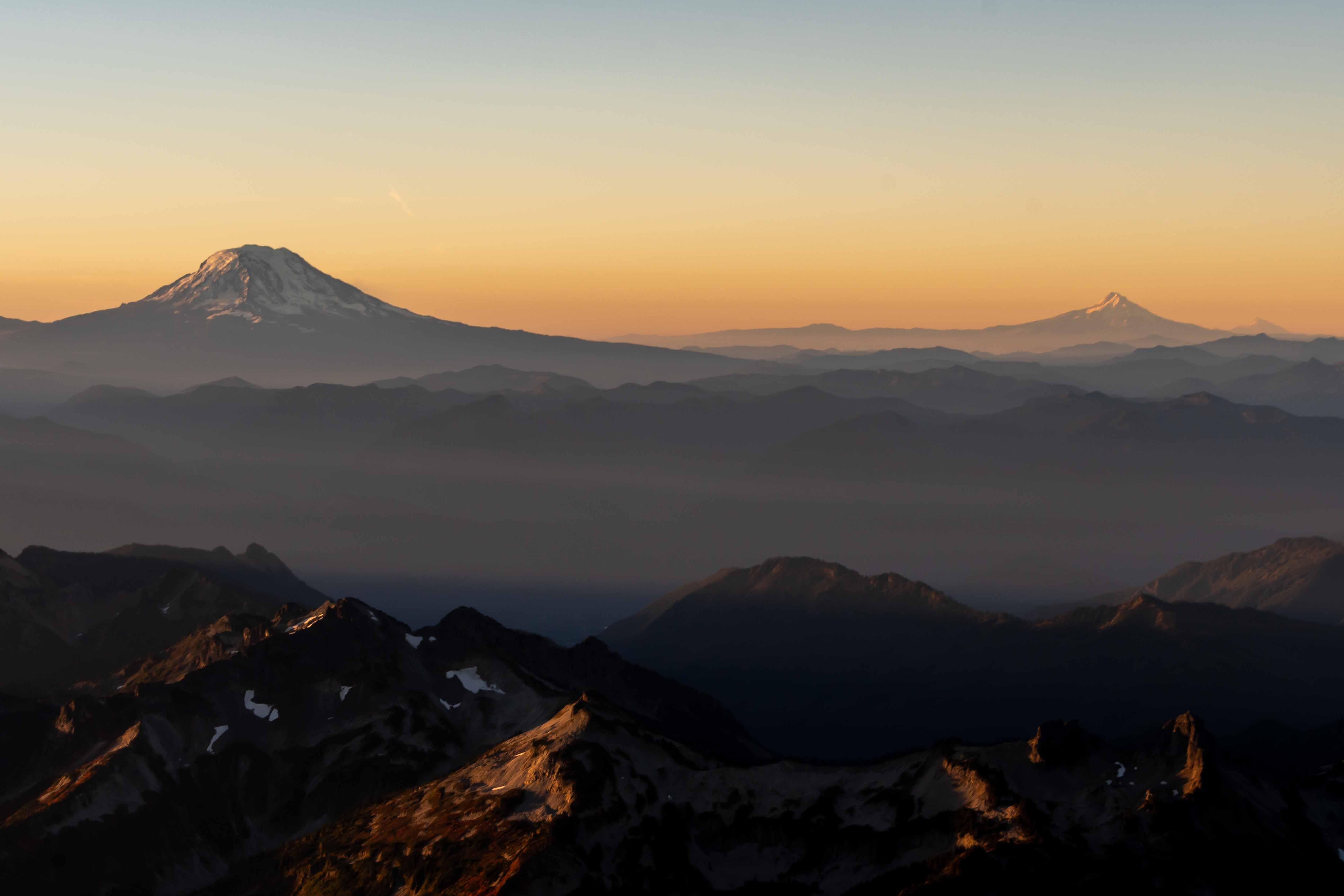
A thousand feet or more from the summit, we stood in the middle of an active avalanche field with nothing to look down on but the entire world. We were exposed to the stillness of the night as the sun began to burn the horizon. And under the brilliant wound cutting through the darkness, a series of mountain ranges protected clouds resting in their valleys. It was a place where time and cold and risk did not apply, but we did not exist in those soft valleys, and the day would soon catch us.
We jumped, crawled, and balanced our way across the upper Nisqually Glacier. The guides and their clients passed us as we rested. One fall on this section would have taken the entire team thousands of feet down into the waiting cold of the inner mountain. No competition would be warranted at this point. The final push was the most difficult. The slope mellowed; the air thinned. Each step became something that wasn’t heavy but carried the weight of a mile at sea level. We neared the crater. Daylight had stolen the night. With a push from the windy freedom of the open sky, we were there. 14,411 feet. Rainier and the rest on the continental United States lay beneath our feet. We spent no more than 20 minutes on the summit, just enough time for photos, a piss, and a snack. Dan hoisted his backpack to his shoulders and reminded us that Camp Muir wasn’t getting any closer.
Descending Rainier was unlike coming down any other mountain I’d climbed. Descending here was like descending into myself. Before I knew it, I’d be back in Salt Lake City, and soon enough I found myself on a Greyhound bus crossing into Utah. I somehow couldn’t comprehend how time’s persistence took the mountain from me as the road carried me nearer to the van I call home. Home was more of a question than a comfort, and I wanted to return to the embrace of a mountain that was too busy herself to stop me from living my dream.
Originally published on Rolling Writer in 2018. Republished here in April 2026.