A second website for the same product makes both weaker
Four things that are true about search, and what they add up to when you split one brand.
A client asked me this week whether he should start a second brand. Same buildings, new name, aimed at a new part of the country. He also asked whether his steel buildings and his wood buildings should each get their own website. He has asked me a version of this three times this year. Every time I say no. Every time I explain it badly. This is the explanation I owed him.
It comes down to four things that are true about search. None of them is hard on its own. Put together, they answer the question and the three objections that come right after it.
1. Rank is a contest, not a score
For every search, Google takes the sites that answer it and puts them in one order. No site gets a grade on its own. Each one is placed above or below the others. Google describes its own job as finding relevant pages and then prioritizing the ones that seem most helpful. Prioritize means order.
Why this matters. You can lose a spot without changing a thing. If a rival gains, you drop. Holding a spot means adding faster than the sites around you.
2. What earns rank is tied to one address
What moves a site up that order? Links from other sites. Pages you have published. Years of history. People who type your name. Google says outright that links from other prominent websites are a sign the content is trustworthy. Every one of those signals is recorded against the domain, not the company.
A new domain you own starts with none of it. Google only carries what a domain earned to a new address when you move the whole site with redirects. Its own site move guide says permanent redirects keep the link credit, and even then it warns to expect ranking to wobble for weeks while the move settles. That is a move. Adding a second address is not a move. Nothing carries. The new site starts empty, even though you own both.
3. A second site splits everything you add from now on
From the day the second site goes live, every new link, mention, review and page lands on one site or the other. Each one grows at half speed. Your rivals keep growing at full speed. Rank is a contest, so a site that adds at half speed slides against sites that never slowed down.
Why it gets worse over time, not better. Growth in search compounds. Rank brings clicks. Clicks bring links and people searching your name. Those bring more rank. Two halves compounding on their own grow slower every month than one whole. The gap between you and the sites around you does not settle. It widens.
4. Lower spots pay far less than the spot you gave up
Here is roughly how 100 searchers split across a normal ten-result page, using Ubersuggest’s click model. First place takes about 30 of them. Second takes about 16. Third takes about 10. Fifth takes about 5. Eighth takes about 2. Tenth takes about 1. Page two takes almost none. Ahrefs measures 96.6% of all Google clicks landing on page one. When an AI answer sits above the results, the top result loses about 58% of its clicks on top of that.
Why the curve is so steep. People read the list from the top and stop at the first result that looks right. Almost nobody reaches the bottom. So two or three lower spots pay less than one higher spot, every time.
Add it up
Say your one site holds third place. That is about 10 of every 100 searchers. Split the same effort across three sites and none of them holds third, because each one has a third of the signals and grows at a third of the speed. Say they land fifth, eighth and tenth. That is 5 plus 2 plus 1. Eight of 100. You tripled the cost and lost clicks, and that is the generous version.
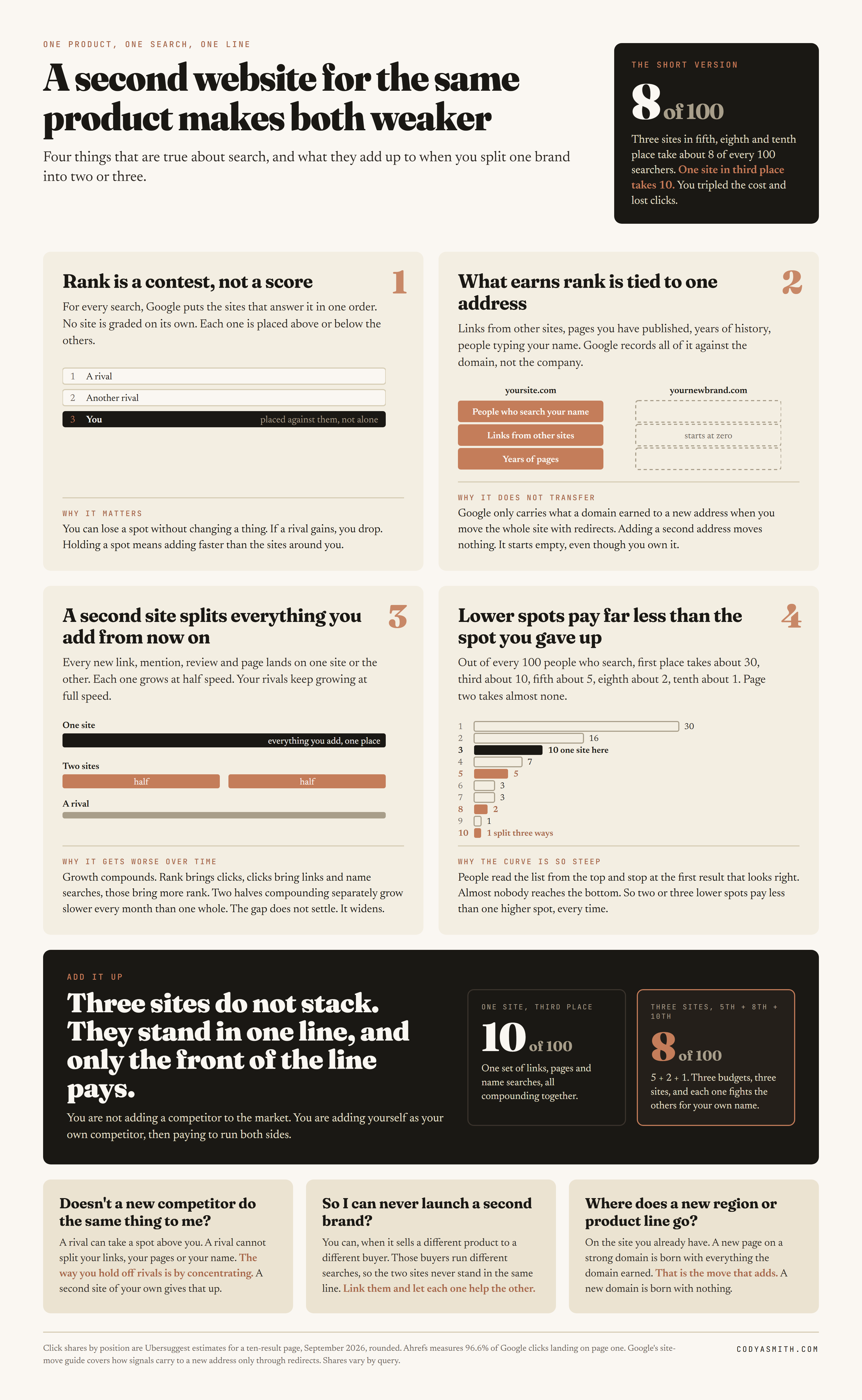
You are not adding a competitor to the market. You are adding yourself as your own competitor, then paying to run both sides. Google’s spam policy has a name for the extreme version, doorway pages, which are several sites or pages built to catch the same searches and funnel people to one place.
The three questions that come next
Doesn’t a new competitor do the same thing to me? A rival can take a spot above you. A rival cannot split your links, your pages or your name. The way you hold off rivals is by concentrating everything you earn in one place. A second site of your own gives that up. It is the one competitor that hurts you twice.
So I can never launch a second brand? You can, when it sells a different product to a different buyer. Those buyers run different searches, so the two sites never stand in the same line. Link them and let each one help the other. The brand research says the same thing from the other direction. Hsu, Fournier and Srinivasan found in 2016 that sub-brands do not wall off risk from the parent company. They spread it. Rao, Agarwal and Dahlhoff found in 2004 that companies mixing a corporate brand with sub-brands are valued lower than companies that commit to one house brand. Commit to one name, or build a brand with no visible tie to the first. The middle is the worst place to stand.
Where does a new region or product line go? On the site you already have. A new page on a strong domain is born with everything the domain earned. That is the move that adds. A new domain is born with nothing. A new region is a page, a Google Business Profile for the branch, and a way for the buyer to see the facts for their state. A new material is a section. Steel and wood are two rooms in one house, not two houses.
Three sites do not stack. They stand in one line, and only the front of the line pays.